



Fiber-Optic FPV Drones Explained: A Wholesale Buyer's Guide to Tethered UAV Technology
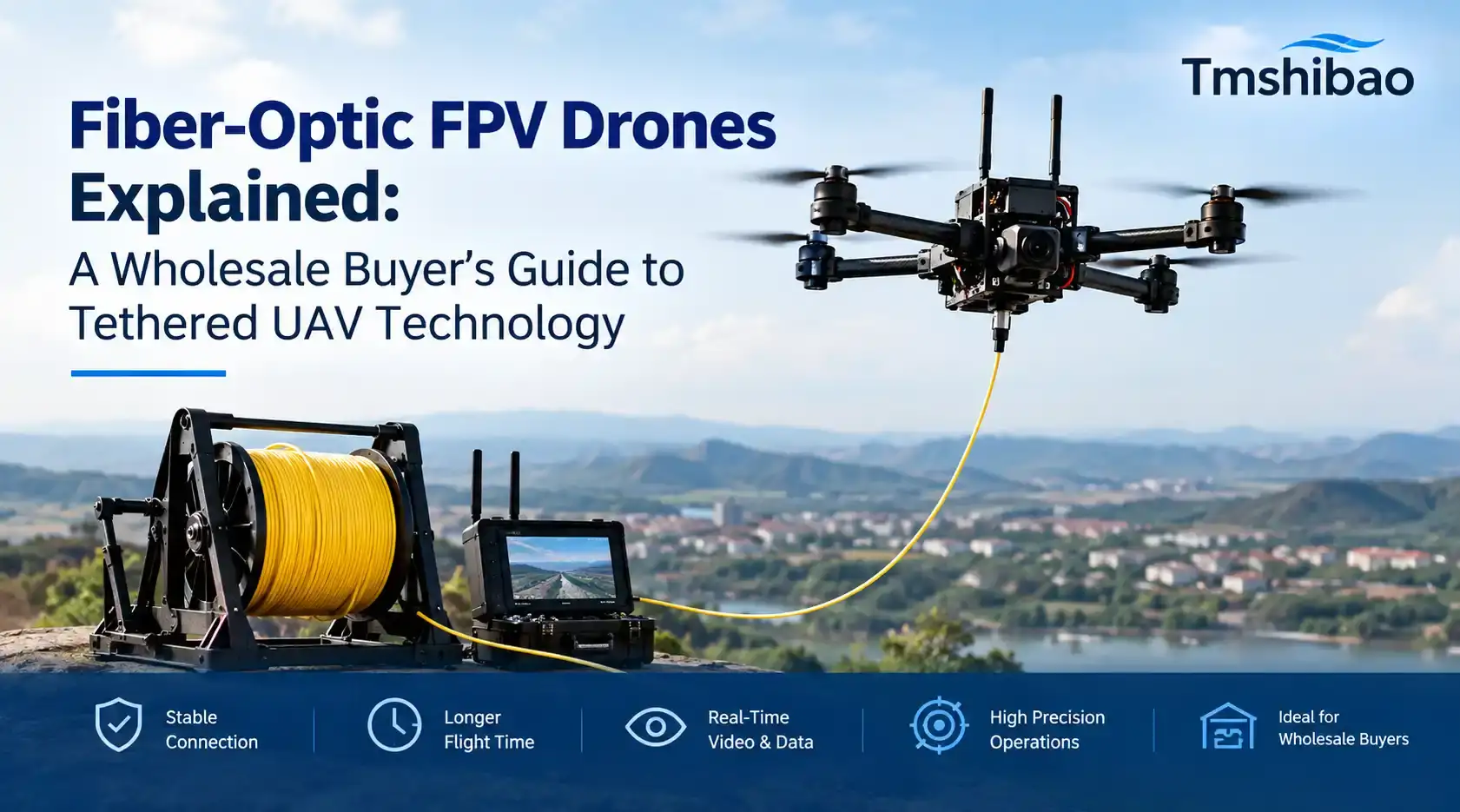
Treasure Marine provides UAV-related products and components for buyers exploring FPV drone technology, heavy-lift platforms, and specialized communication equipment. Fiber-optic FPV drones are an important technology to understand when evaluating aircraft that use a physical optical-fiber connection for compatible control or video data. For wholesalers, distributors, and commercial buyers, selecting the right spool, communication module, and airframe requires careful attention to compatibility, specifications, and procurement requirements.
As demand for specialized unmanned aerial vehicle (UAV) components develops, buyers need reliable product information before making purchasing decisions. Fiber-optic communication differs from conventional radio-frequency (RF) communication because supported data travels through a physical fiber connection rather than solely through a wireless link. This distinction makes the technology relevant to certain applications where communication architecture, operating conditions, and equipment compatibility are important considerations.
For B2B buyers, understanding the complete system is more useful than comparing individual product prices alone. Spool length, onboard equipment weight, aircraft endurance, mounting arrangements, and the availability of technical documentation can all affect a purchasing decision. This guide explores how fiber-optic FPV drone systems work, compares optical fiber spool options, introduces compatible product categories, and explains what wholesale buyers should confirm before requesting a quotation.
Why Are Wholesale Buyers Exploring Fiber-Optic FPV Drones?
Wholesale buyers often evaluate drone components according to their intended application, technical requirements, purchasing volume, and long-term supply needs. Fiber-optic FPV Parts technology introduces a different communication approach that may suit certain specialized configurations. Understanding its characteristics helps distributors, UAV integrators, and businesses identify the equipment they need and ask suppliers more informed questions before ordering.
Understanding Fiber-Optic Communication
A fiber-optic communication system transmits supported data as optical signals through a physical fiber. Unlike a conventional RF connection, the fiber-based link does not depend on radio waves traveling through the air between the connected endpoints. The precise capabilities depend on the communication module, ground equipment, connectors, supported protocols, and the architecture of the complete system.
Communication Reliability and System Limitations
One consideration for buyers is that a physical fiber link is not directly affected by conventional over-the-air RF jamming of that link. However, this does not mean the entire aircraft is immune to interference or disruption. Other systems, including navigation, power, electronics, and any wireless connections, may have separate limitations that buyers should understand before selecting a configuration.
Planning for Wholesale Orders
For wholesalers and distributors, the purchasing process should include more than choosing a product by name. Buyers should confirm the available configurations, minimum order quantities, production lead times, replacement-part availability, and whether technical documentation is supplied. When sourcing several units, checking that components match the intended configuration can also reduce avoidable integration problems and make inventory planning easier.
Identifying Suitable Applications
The suitability of a fiber-optic FPV system depends on its design and the environment in which it will be used. Specialized research, controlled testing, and certain industrial applications may have communication requirements that justify considering a physical optical link. Buyers should assess the complete aircraft, applicable regulations, operating limitations, and safety requirements rather than assuming every fiber-optic system fits every use case.
How Does a Fiber-Optic FPV Drone System Work?
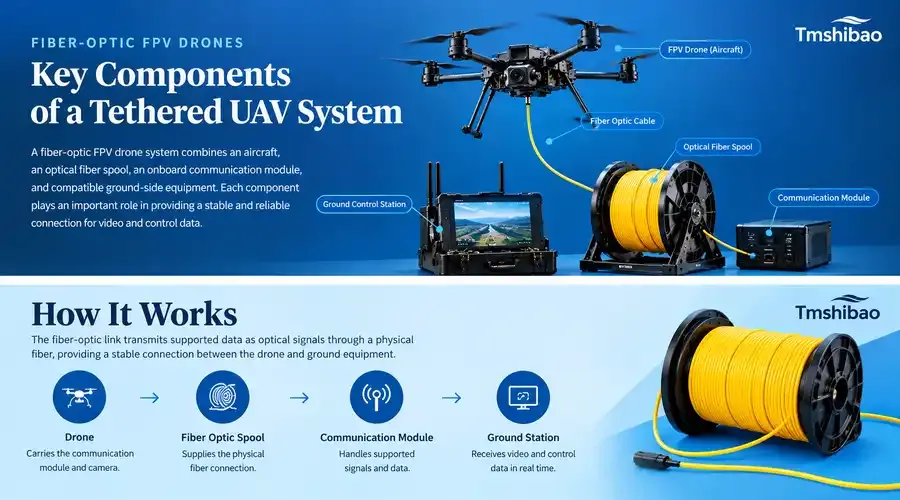
A fiber-optic FPV drone system typically combines an aircraft, an optical fiber spool, an onboard communication module, and compatible ground-side equipment. The spool supplies the physical fiber connection, while the communication electronics handle the supported signals. The aircraft must also provide suitable mounting space, electrical power, and payload capacity for the complete installation.
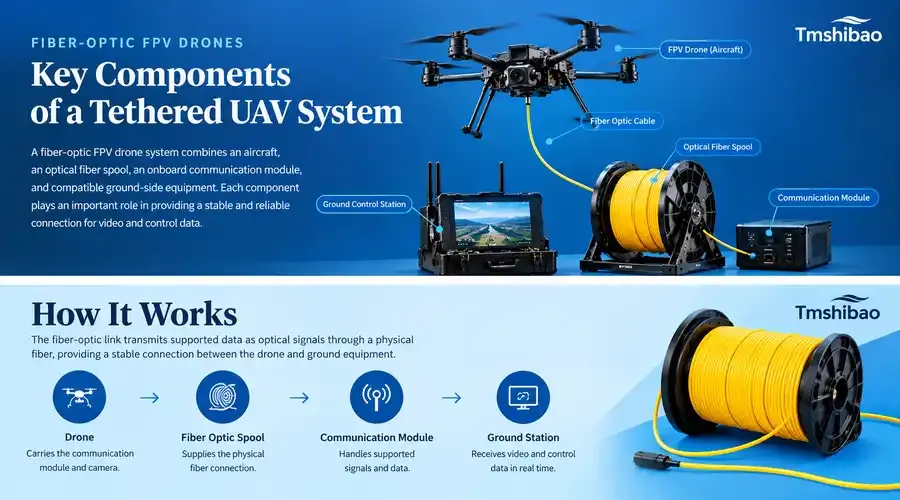
Understanding how these components work together helps B2B buyers evaluate products more accurately. A spool and aerial module should not automatically be treated as universally compatible accessories, because connector types, communication protocols, power requirements, and installation arrangements can differ. Before purchasing a complete configuration or ordering components separately, request confirmation that the selected products are designed to work together.
What Is an Optical Fiber Spool?
An optical fiber spool stores the fiber used to connect compatible aircraft equipment with a ground-side communication system. As fiber is deployed during operation, the remaining available length decreases. The spool's nominal length is an important specification, but actual usable distance also depends on fiber routing, installation requirements, reserve length, and the aircraft's operating limits.
For wholesale buyers, the spool's physical characteristics matter alongside its stated length. Weight, dimensions, mounting requirements, fiber specifications, and compatibility with the aerial communication module should all be reviewed. These details help buyers assess whether the equipment fits the intended aircraft and whether additional accessories or installation components may be needed before the system can be used.
What Does the Aerial Communication Module Do?
The aerial communication module provides an interface between the optical fiber and compatible onboard electronics. Depending on the specific product, the system may support control signals, video data, or other information specified by the manufacturer. Buyers should verify the module's supported functions instead of assuming that every product provides the same communication capabilities or works with every FPV platform.
When comparing modules, check the technical datasheet for connector types, power requirements, supported protocols, dimensions, and ground-side equipment requirements. If the module is sold together with a spool, confirm exactly which items are included in the package. For bulk purchasing, obtaining these details in writing can make it easier to compare supplier quotations and plan a consistent component configuration.
Comparing 5km, 10km, 15km, and 20km Optical Fiber Spools
Treasure Marine's listed product range includes several nominal fiber-length options for buyers to evaluate. These include 5km, 10km, 15km, and 20km optical fiber spools with associated aerial-module descriptions in their product names. Each option should be assessed against the required configuration, total equipment weight, fiber specifications, and the manufacturer's stated operating limitations.
A longer spool does not automatically mean that an aircraft can achieve the same distance as the stated fiber length. The actual usable operating distance depends on the deployed fiber path, routing and reserve requirements, aircraft endurance, and system configuration. Buyers should therefore treat spool length as one part of the specification rather than a guaranteed flight radius.
5km Fiber-Optic Spool with Aerial Communication Module
5km Fiber-Optic Spool with Aerial Communication Module is an option for buyers comparing shorter nominal fiber-length configurations. Before ordering, review its included components, weight, dimensions, communication interfaces, and compatibility with the intended aircraft and ground equipment. These details are especially relevant when comparing the spool with other available lengths.
10km Optical Fiber Spool with Aerial Module
10km Optical Fiber Spool with Aerial Module provides another nominal length option for UAV equipment buyers. When assessing this product, confirm the supported fiber specifications and the installation requirements of the aerial module. Buyers planning multiple units should also request the current quotation, package contents, availability, and any technical documentation required for integration.
15km Optical Fiber Spool with Aerial Module
15km Optical Fiber Spool with Aerial Module is listed for buyers considering a longer nominal fiber-length configuration. Its suitability depends on the complete system rather than spool length alone. Confirm the equipment's weight, mounting arrangement, compatibility, and supported operating conditions before deciding whether it meets your purchasing requirements.
20km Optical Fiber Spool with Aerial Module
20km Optical Fiber Spool with Aerial Module is the longest nominal spool-length option in this listed range. Buyers evaluating it should pay particular attention to the manufacturer's specifications and the effect of the complete installation on aircraft payload and endurance. Request confirmation of the intended configuration rather than assuming the full fiber length represents a guaranteed operating distance.
Choosing the Right Fiber-Optic-Ready FPV Drone Frame
The airframe determines the physical platform on which the communication equipment and other components are installed. Buyers should assess payload allowance, mounting space, power-system requirements, battery configuration, and the aircraft's published specifications. A frame described as fiber-optic-ready may be intended for a particular system, but compatibility with the exact spool and communication module should still be confirmed.
Treasure Marine's product range includes dedicated fiber-optic versions of heavy-lift FPV quadcopters. These products can be evaluated by buyers by comparing airframe dimensions, power-system designations, and the configuration stated in each product listing. When requesting a quotation, ask the supplier to identify the included components and clarify which specifications apply to the complete aircraft rather than an individual frame or accessory.
Fengren 15 Fiber-Optic Version Heavy-Lift FPV Quadcopter
Fengren 15 Fiber-Optic Version Heavy-Lift FPV Quadcopter is listed as a heavy-lift FPV platform with a fiber-optic version and an 8S power-system designation. Buyers researching this product should review the manufacturer's information for payload allowance, battery requirements, mounting arrangements, supported communication equipment, and the components included with the selected configuration.
For distributors and commercial buyers, the most important step is to establish how the complete system will be supplied. Confirm whether the relevant spool and aerial communication module are included or need to be purchased separately. It is also useful to request the aircraft's weight and payload specifications in writing so that the intended equipment can be evaluated against the stated operating limits.
18-Inch Fiber-Optic Version Heavy-Lift FPV Quadcopter
18-Inch Fiber-Optic Version Heavy-Lift FPV Quadcopter is listed as an 18-inch heavy-lift platform with a fiber-optic version and a 12S power-system designation. Buyers comparing this model should examine the frame dimensions, battery and electrical requirements, payload allowance, and mounting provisions specified by the manufacturer.
When evaluating an 18-inch platform, consider the weight of every installed component rather than the airframe alone. The spool, communication module, battery, mounting hardware, and any additional equipment contribute to the complete configuration. Request clarification on supported accessories and installation requirements before placing a wholesale order, particularly if the same configuration needs to be reproduced across multiple units.
What Should Buyers Check Before Ordering?
Before purchasing a fiber-optic-ready drone frame, confirm that the selected communication equipment is compatible with the aircraft's electrical and physical interfaces. Review the available payload allowance after accounting for the battery and all installed accessories. Check the mounting dimensions, connector requirements, and supported configuration so that the selected components can be evaluated as a complete system.
B2B buyers should also request product documentation, replacement-part information, warranty conditions, and current supply details. If the aircraft will be integrated into a larger UAV system, confirm which integration responsibilities belong to the supplier and which require separate engineering work. Clear documentation can help businesses compare quotations and identify any missing components before committing to a larger purchase.
How to Choose the Right Fiber-Optic FPV Drone Configuration
Selecting a configuration begins with identifying the technical requirements and then matching them with compatible components. A suitable spool length cannot compensate for an incompatible communication module, and a heavy-lift frame does not automatically support every payload arrangement. Buyers should compare the complete system specifications and ask the supplier to clarify any information that is not provided in the product listing.
Select the Appropriate Fiber Length
Start by identifying the required fiber-link length and reviewing the planned routing and installation requirements. Compare the 5km, 10km, 15km, and 20km options according to the intended configuration rather than choosing solely by the largest number. The manufacturer's specifications should clarify the fiber type, spool characteristics, and any operating restrictions associated with each product.
Calculate the Complete Payload
The total installed weight includes more than the drone's frame. Batteries, communication modules, optical fiber spools, mounting hardware, and additional equipment all contribute to the complete configuration. Ask for the aircraft's payload specifications and determine whether the selected components fit within the manufacturer's limits. Do not assume that a maximum payload figure automatically applies to every operating condition.
Confirm Electrical and Communication Compatibility
Check the power requirements, supported interfaces, connector types, and communication protocols for the selected equipment. Confirm that the ground-side system and onboard module are compatible with one another and with the intended aircraft electronics. If technical details are unavailable, request clarification before ordering instead of relying on assumptions based on product names or general descriptions.
Evaluate Wholesale Pricing and Supply Requirements
Wholesale purchasing often involves several commercial considerations, including minimum order quantities, volume pricing, sample availability, lead times, packaging, and after-sales support. Ask for a quotation that clearly identifies the product configuration, included accessories, delivery terms, and any additional costs. Comparing quotations using the same technical requirements makes it easier to understand differences in what each supplier is offering.
Review Documentation and After-Sales Support
Technical documentation is useful when products need to be integrated, inspected, maintained, or reordered. Ask whether the supplier provides datasheets, installation information, warranty terms, replacement components, and technical support. For repeat orders, confirm whether the same configuration can be supplied again and how any changes in components or specifications will be communicated.
Related Heavy-Lift and Long-Range FPV Drone Products
In addition to fiber-optic equipment, buyers may want to compare other FPV platforms and UAV-related components. Different products serve different design requirements, and conventional FPV drones should not automatically be assumed to support optical fiber communication. Treasure Marine's related listings provide additional options for buyers who are reviewing the wider product range.
Fengren 10 Heavy-Lift FPV Drone
Fengren 10 10-Inch Heavy-Lift Long-Range FPV Drone is listed as a heavy-lift FPV quadcopter with an advertised maximum payload of 4kg. Buyers should consult the product specifications to understand the conditions attached to this rating, along with the frame dimensions, battery requirements, and supported equipment.
For wholesale procurement, evaluate this model according to the actual application and the components that need to be installed. Confirm whether the listed payload figure applies to the intended configuration and whether the product supports any separately required accessories. Its fiber-optic compatibility should be verified independently rather than inferred from its heavy-lift or long-range description.
Fengren 13 Heavy-Lift FPV Drone
Fengren 13 13-Inch Heavy-Lift FPV Drone is listed with an advertised maximum payload of 7kg and an 8S power-system designation. Buyers should check the published specifications, including the conditions associated with its payload rating, before comparing it with other platforms.
When evaluating the Fengren 13, consider the intended installed equipment, the required battery configuration, and the availability of replacement parts. For business buyers placing larger orders, request a written specification sheet and current pricing. As with other conventional FPV platforms, do not assume that the aircraft supports a fiber-optic communication system unless the manufacturer confirms compatibility.
7-Inch Folding FPV Drone
7-Inch Folding FPV Drone with 1500TVL Camera and GPS Navigation is listed as a folding FPV quadcopter featuring a 1500TVL camera and GPS navigation. Buyers can review this product when comparing conventional FPV platforms, folding-frame designs, and the features stated in its product listing.
Before ordering, confirm the dimensions, supported accessories, electrical requirements, and other specifications relevant to the intended application. If the product is being considered alongside fiber-optic equipment, ask the supplier whether the necessary interfaces and mounting arrangements are supported. Its listed features alone do not establish compatibility with a separate optical fiber spool or communication module.
Xingkong-80 Turbojet Engine
Xingkong-80 Turbojet Engine is a separate propulsion product listed with a 78 daN thrust rating. It belongs to a different product category from conventional multirotor FPV quadcopters, so buyers should evaluate it independently according to its intended platform and the manufacturer's technical documentation.
For distributors researching a broader UAV-related catalog, the Xingkong-80 can be reviewed as a specialized propulsion component rather than a standard part of a fiber-optic FPV drone system. Confirm the product specifications, intended compatibility, and purchasing requirements before requesting a quotation. Keeping this distinction clear helps buyers understand which components belong to the same system and which serve different engineering purposes.
Frequently Asked Questions About Fiber-Optic FPV Drones
How Far Can a Fiber-Optic FPV Drone Fly?
The usable operating distance depends on the available fiber length, fiber routing, reserve requirements, aircraft endurance, installed payload, and manufacturer specifications. A spool advertised as 5km, 10km, 15km, or 20km does not guarantee the same flight radius. Buyers should request details about the complete system and its operating limitations before choosing a configuration.
Is Fiber-Optic Communication Better Than RF for FPV Drones?
Fiber-optic and RF communication use different transmission methods, and their suitability depends on the requirements of the application. Fiber carries data through a physical optical connection, while RF communication transmits signals wirelessly. A fiber link is not directly affected by conventional over-the-air RF jamming of that link, but it introduces physical fiber handling and deployment considerations.
Can an Optical Fiber Spool Be Installed on Any FPV Drone?
No, compatibility should not be assumed. The aircraft must support the necessary payload, mounting arrangement, electrical requirements, and communication interfaces. The optical fiber spool, aerial communication module, ground-side equipment, and onboard electronics must also work together. Buyers should obtain compatibility confirmation from the supplier before purchasing components separately or ordering multiple units.
What Should Wholesale Buyers Ask a Fiber-Optic Drone Supplier?
Buyers should ask for product datasheets, spool specifications, module compatibility details, supported airframes, minimum order quantities, sample availability, volume pricing, production lead times, and warranty terms. It is also important to clarify which components are included, whether installation accessories are required, and what technical support is available. A written quotation should identify the exact configuration being supplied.
What Information Is Needed Before Requesting a Wholesale Quotation?
Prepare a list of the products and quantities you want to purchase, the required spool lengths, and any known compatibility requirements. Include the intended aircraft model and ask the supplier to confirm the relevant interfaces, specifications, and included accessories. Providing this information early can make the quotation process clearer and help identify technical questions before the order is finalized.
Source Fiber-Optic FPV Drone Components from Treasure Marine
Choosing a fiber-optic FPV drone configuration requires attention to communication equipment, spool length, payload capacity, electrical compatibility, and the requirements of the complete aircraft. Wholesale buyers should review these factors together rather than selecting products solely on the basis of a headline specification. Clear technical documentation and a detailed quotation can help establish what is included and what additional components may be required.
Treasure Marine's product range includes optical fiber spool options, dedicated fiber-optic FPV airframes, heavy-lift quadcopters, and other UAV-related components for buyers researching available configurations. Explore the FPV parts and components collection to review relevant listings, compare product specifications, and identify items for further evaluation.
If you are a wholesaler, distributor, or business sourcing UAV components in larger quantities, prepare your product list and purchasing requirements before contacting the supplier. Request current pricing, minimum order quantities, lead times, technical documentation, and confirmation of component compatibility. You can then contact Treasure Marine to discuss your wholesale inquiry and request a quotation for the products that match your requirements.
Featured Articles
Leave Your Comments
Treasure Marine (Shibaohai (Liaoyang) Trading Co., Ltd.)

Have a question or need a quote? Fill out this form and our team will get back to you quickly!