



Ultimate Guide to Fiber-Optic FPV Drones: Setup, Operation, and Best Use Cases
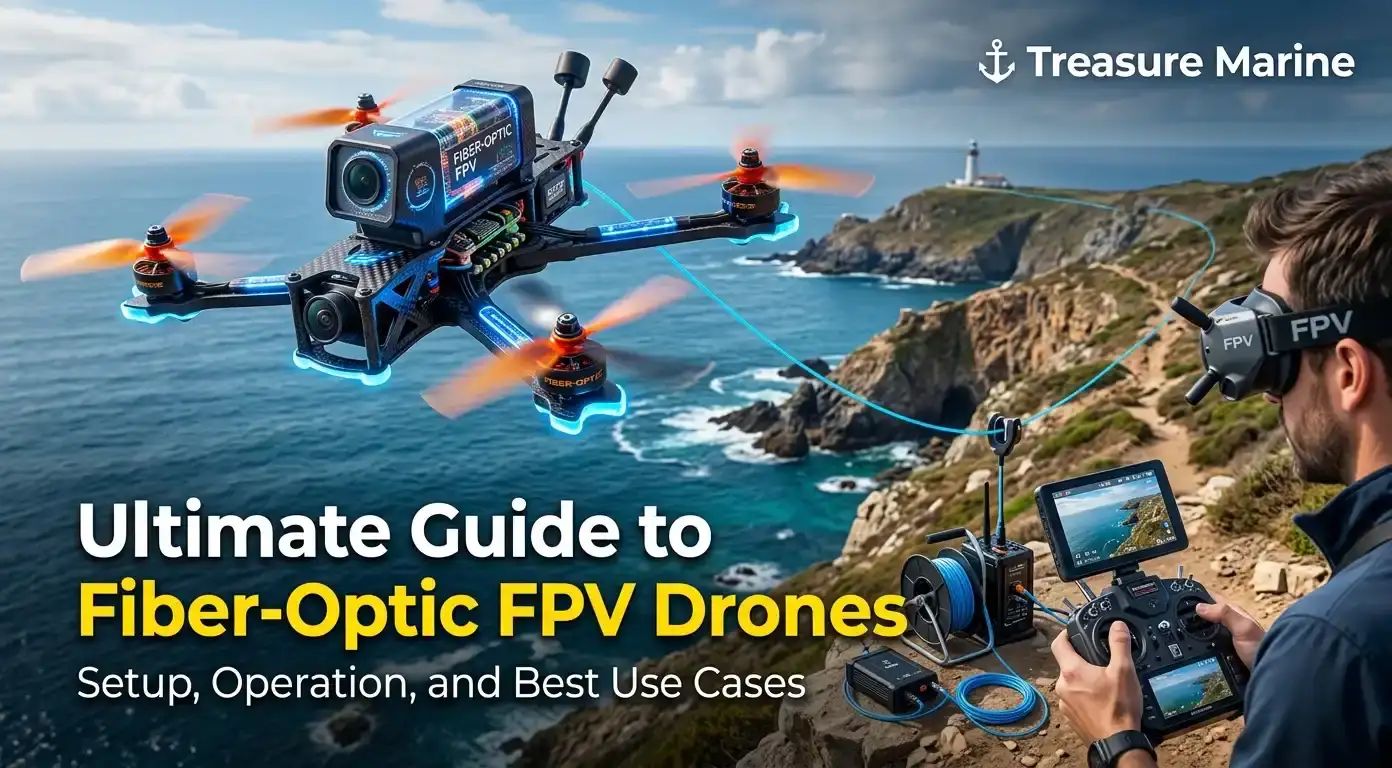
At Treasure Marine, we work closely with commercial buyers who depend on drones in places where ordinary wireless links simply give up. Concrete plants, tunnels, refineries, and high-voltage corridors all punish radio signals, and a dropped video feed can ruin an inspection, damage expensive equipment, or put a crew at risk. Fiber-optic FPV drones answer that problem by replacing radio with light. This guide explains how the technology works, what to buy, and where it pays off.
The Hidden Cost of Wireless Failure
Most enterprise teams underestimate how often radio links fail until a mission is already compromised. Signal loss behind steel walls, interference from heavy machinery, and electromagnetic noise near power infrastructure all degrade video quality and control response. Each failure carries a cost, including repeated site visits, lost flight hours, crashed airframes, and delayed safety reports. When an operator cannot trust the link, every flight becomes a gamble, and procurement teams end up paying for that uncertainty again and again.
The Shift to Optical Technology
Fiber-optic FPV drones trail an ultra-thin glass fiber behind the aircraft, carrying video, telemetry, and control data as pulses of light between the drone and the operator. Because nothing is broadcast, there is nothing to jam, intercept, or disturb with electromagnetic noise. For buyers in demanding environments, this makes optical technology the most dependable link available today. The result is a stable, clean feed that stays consistent no matter what surrounds the aircraft.
What This Guide Covers
This guide is built as a procurement and operational roadmap for B2B buyers. It starts with system architecture and performance, then moves through motor selection, accessories, setup, and piloting practices. After that, it examines the commercial use cases that deliver measurable returns. It closes with a practical buyer's checklist covering range, total cost of ownership, and vendor support, so your team can compare suppliers with confidence and avoid costly specification mistakes before signing a purchase order.
Read this blog: Fiber-Optic FPV Drones Explained: A Wholesale Buyer's Guide to Tethered UAV Technology
Anatomy of a Fiber-Optic FPV System: How Light Replaces Radio Waves
Core Architecture
A fiber-optic FPV system has three main building blocks working together. An airborne optical transceiver converts camera and flight data into light, a ground media converter turns that light back into electrical signals for the goggles and controller, and a spool of fiber connects the two. The spool pays out as the drone flies, so the link stays continuous. Every component must be matched carefully, because a weak connection anywhere along the chain limits the whole system.
The fiber itself deserves special attention. Bend-insensitive types such as G657A2 and B3 are the common choice because they tolerate tight turns, vibration, and winding on a compact spool without losing meaningful signal strength. Their thin diameter keeps weight low and allows long lengths to fit inside a small canister. When evaluating suppliers, ask about coating quality, tensile strength, and winding method, since these details decide whether the cable unwinds cleanly or snags during a demanding flight.
Performance Metrics
Latency is the headline advantage of optical links. Well-built systems deliver video with delays in the range of 5 to 10 milliseconds, which feels effectively instant to a pilot flying through tight spaces. Because the signal travels as light with no compression or error correction delays, the image stays sharp and responsive. For inspection work near obstacles, this speed lets operators correct course early and avoid collisions that slower digital video systems would make almost unavoidable.
Immunity to electromagnetic interference is the second major metric. A glass fiber does not conduct electricity and does not pick up radio noise, so the link holds steady beside transformers, motors, welding stations, and live power lines. Buyers should still verify the full chain, because the drone's own electronics and power wiring can generate noise. A properly shielded and grounded build keeps that noise away from the transceivers and preserves the clean signal the optical link promises.
Why Wireless Falls Short
Radio waves struggle with physical barriers. Reinforced concrete, steel plant structures, long tunnels, and dense equipment rooms absorb or reflect signals, creating dead zones where video freezes or control is lost. Operators then have to fly higher or closer to the ground station, which defeats the purpose of the inspection. In these locations, even strong transmitters and high-gain antennas deliver unreliable results, and the cost of repeated failures quickly outweighs the savings of a cheaper wireless setup.
Power grids and industrial sites add another challenge, because they generate heavy electromagnetic noise that overwhelms receivers. A wireless drone flying near high-voltage equipment may show interference, stutter, or unexpected failsafe behavior. A wired optical link avoids these problems by design. For safety inspectors and operations managers who need predictable results on every flight, this reliability justifies the extra attention required to manage a fiber spool and the tether behind the aircraft.
Choosing the Optimal Drone Motor for Fiber-Optic Systems
Accounting for Payload Weight
The fiber spool canister adds real weight to the airframe, and that weight grows with cable length. A 20 km spool carries far more mass than a 5 km one, so motor selection must start with an honest payload calculation. Include the canister, fiber, transceiver, battery, and camera in your total. Undersized motors will struggle with this load, drain batteries quickly, and respond sluggishly, which reduces both flight time and the operator's confidence during delicate maneuvers.
Selecting the right motor is therefore a procurement decision, not an afterthought. Buyers should request thrust data at several throttle levels and confirm that the airframe still has comfortable headroom when fully loaded. A good rule is to choose motors that hold stable hover at a moderate throttle position while carrying the complete system. This margin gives pilots room to climb, brake, and recover from unexpected tether drag without pushing the motors to their limits.
Power-to-Weight Ratios and Thrust
A high power-to-weight ratio keeps the drone agile even while dragging a thin cable behind it. Tether drag is small but constant, and it increases as more fiber pays out and catches air resistance. Drone Motors with strong, consistent thrust let the aircraft hold speed and heading without constant correction. When comparing options, look at measured thrust per watt, propeller pairing, and response behavior, rather than relying only on a single maximum thrust figure printed on a datasheet.
Stability at speed matters just as much as raw power. Fiber systems excel at fast, directional flight, so motors must respond cleanly to rapid throttle changes without oscillation or overheating. Smooth, well-balanced motors reduce vibration, which protects the optical transceiver, camera, and spool mount. Ask suppliers about bearing quality, magnet grade, and balancing standards. These details often separate reliable commercial hardware from low-cost parts that perform well in a short bench test but disappoint in real field conditions.
Thermal Efficiency and Durability
Industrial missions are rarely short, and motors that run hot lose efficiency and wear out faster. Good thermal design, including ventilated bells, quality windings, and sensible propeller choices, keeps temperatures under control during long flights in warm plants or enclosed spaces. Overheating can demagnetize components over time and shorten service life. Buyers who plan repeated daily operations should favor motors with proven durability, since downtime and replacement costs add up faster than any initial saving on cheaper parts.
ESC Compatibility
The electronic speed controller must match the motor's KV rating, voltage, and current demands. A mismatch can cause desync, overheating, or unpredictable throttle response, all of which are dangerous when the aircraft is tethered in a confined space. Choose ESCs with ample current headroom and firmware suited to your flight style. Confirm that the controller handles rapid throttle changes smoothly, because tether drag and fast directional flight place unique demands on the motor and ESC pairing.
Essential Drone Accessories for Seamless Commercial Operations
Airborne and Ground Optical Transceivers
Optical transceivers are the most important accessories in the system. The airborne unit converts video, telemetry, and control signals into light, while the ground unit reverses the process without compression loss. Their quality determines image clarity, latency, and reliability. Buyers should check weight, power draw, connector type, and thermal behavior, because a heavy or power-hungry transceiver cuts into flight time. Reputable suppliers will provide test data and clear compatibility information for common flight controllers and cameras.
Passive Fiber Spool Canisters
The spool canister holds the fiber and releases it as the drone flies. A well-designed canister uses low-drag housing and precise winding so the cable leaves smoothly without twisting or snapping. Poor winding causes tangles, and tangles end missions. Because the canister mounts on the airframe, its shape also affects aerodynamics and balance. Ask whether spare canisters are available, since quick swaps between flights allow teams to maintain a high operational tempo during larger inspection campaigns.
WDM and TDM Signal Multiplexing Modules
A single thin fiber can carry far more than video. Wavelength division and time division multiplexing modules allow high-definition video, telemetry, and bidirectional control signals to share one strand without interfering with each other. This keeps the cable light while supporting rich data flow. Buyers should confirm which multiplexing method a system uses, what bandwidth it supports, and whether the modules can be upgraded, because these choices determine how well the platform adapts to future payloads and sensors.
Ground Power Stations and Backup Converters
Long-range missions need dependable energy on the ground. Power stations keep transceivers, converters, and displays running through extended operations, while backup converters protect against sudden failures. Reliable ground power also prevents data loss during critical inspections. When selecting these accessories, consider portability, battery capacity, input flexibility, and protection against voltage spikes. A well-chosen power setup keeps the whole system consistent, so one weak accessory never undermines an otherwise strong investment in optical hardware.
Step-by-Step Setup Guide: Deploying Your Fiber-Optic FPV Fleet
Phase 1: Ground Station Assembly
Begin by placing the ground station in a stable, protected location with good visibility of the launch area. Connect the base transceiver, power supply, and display equipment, and verify every connector is clean and fully seated. Dust or fingerprints on optical connectors cause signal loss, so inspect and clean them before each session. Calibrate the base unit according to the manufacturer's instructions, and record settings so the same configuration can be reproduced across multiple sites and operators.
Phase 2: Hardware Integration
Next, mount the airborne optical transceiver on the airframe and secure the fiber spool canister in the position specified for your build. Keep the center of gravity close to the original design, and route wiring away from moving parts and hot components. Fasten everything firmly, since vibration can loosen fittings during flight. Double-check that the fiber exits the canister freely and follows a clear path behind the drone, without touching propellers, landing gear, or sharp edges.
Phase 3: Pre-Flight Validation
Before every mission, validate the optical link and the complete cable path. Confirm the video feed, control response, and telemetry readings on the ground, and run a latency check to ensure results match expectations. Inspect the fiber for visible damage, and verify that the spool is wound correctly. Finally, perform a short test hover to observe tether behavior. This disciplined routine catches most faults early, protecting expensive hardware and keeping operators safe during real missions.
Operational Workflow: Best Practices for Piloting Fiber-Optic Drones
Understanding Flight Dynamics
Fiber-optic drones are purpose-built for fast, directional flight rather than chaotic freestyle acrobatics. The trailing cable limits sudden reversals, tight loops, and repeated flips because these maneuvers can tangle or stress the fiber. Pilots should plan smooth, deliberate routes that move steadily toward the objective. Training new operators with this mindset reduces accidents and extends equipment life, and it helps teams set realistic expectations about what the platform does best.
Cable Management
Managing the cable is the heart of safe operation. Pilots should monitor tension, avoid dragging the fiber across rough surfaces, and plan paths that minimize contact with beams, pipes, and corners. A spotter on the ground can watch for snagging hazards that the pilot cannot see through the camera. In complex architecture, it helps to survey the site beforehand and choose routes that keep the fiber clear of obstacles, so the aircraft can move freely.
Route planning becomes even more important in large facilities with many turns. Each corner adds friction, and friction adds risk of a break or a stalled spool. Wherever possible, select paths with gentle curves and open space. Consider launching from a position that shortens the distance through the most difficult sections. Thoughtful planning before takeoff costs little, yet it often decides whether a mission delivers clear inspection footage or ends with a recovery effort.
Emergency Protocols
Every team needs a written plan for line obstructions and line severing. If the fiber snags, the pilot should stop forward motion, reduce throttle smoothly, and avoid aggressive attempts to pull free. If the line breaks, the drone should follow a defined failsafe, such as a controlled landing or automatic hold. Brief every operator on these procedures, rehearse them during training, and document each incident, so lessons learned improve future missions and strengthen overall safety.
High-Value Commercial Use Cases: Where Fiber-Optic Drones Deliver ROI
Industrial Infrastructure Inspections
Fiber-optic drones can fly inside massive concrete structures, petrochemical facilities, and heavy manufacturing plants where wireless signals rarely survive. They reach tanks, chimneys, ducts, and overhead structures that would otherwise require scaffolding, shutdowns, or rope access teams. This reduces inspection time and exposes fewer people to hazardous conditions. For operations managers, the savings come from avoiding downtime, lowering safety risk, and collecting clearer visual data that supports better maintenance decisions across the facility.
Tunnel, Mining, and Subterranean Exploration
Deep underground, conventional radio frequencies fail almost immediately because rock and soil absorb the signal. A fiber link keeps the video feed and controls stable throughout long tunnels, mine shafts, and culverts. Teams can survey unstable areas, check ventilation routes, and assess damage without sending workers into danger. The ability to maintain constant contact with the aircraft in these environments gives mining and civil engineering organizations a practical tool that conventional wireless drones cannot match.
Energy Sector and Power Grid Monitoring
Close-range structural checks near high-voltage lines demand a link that tolerates intense electromagnetic fields. Optical fiber is non-conductive and unaffected by this noise, so pilots can approach insulators, towers, and substations with a clean, steady feed. Utilities benefit from earlier fault detection and fewer outages. Because the video stays reliable, inspectors can document equipment condition in detail, which supports preventive maintenance programs and helps energy companies protect infrastructure while reducing the need for risky manual climbing.
Specialized Security and Tactical Reconnaissance
In heavy jamming environments, a wired link keeps communication secure and uninterrupted. Security teams and defense procurement leads value this resilience for reconnaissance, perimeter checks, and sensitive site assessments. With no radio emissions to detect or disrupt, the aircraft is harder to counter, and its data stays private. Buyers in this sector should still review local regulations and export requirements carefully, and they should work only with suppliers who can provide proper documentation and transparent support.
B2B Buyer's Checklist: What to Evaluate Before Purchasing
Deployment Range Requirements
Start by defining how far your missions actually need to reach. Spool options commonly range from 5 km to 50 km, and longer cables add weight, cost, and complexity. Choosing more length than necessary reduces flight time and raises expenses without improving results. Map your typical routes, add a sensible safety margin, and select the shortest spool that covers the job. Many buyers keep several spool sizes available, matching each mission to the right configuration.
Total Cost of Ownership
The purchase price is only part of the picture. Total cost of ownership includes spools, which are often consumed or replaced, along with batteries, motors, spare parts, training, and maintenance time. Weigh these ongoing costs against the value of reduced risk, avoided shutdowns, and reliable data. A system that costs more upfront but prevents even one failed inspection or accident can pay for itself quickly, which makes mission-critical reliability the strongest financial argument.
Vendor Customization and Support
Finally, evaluate the supplier as carefully as the product. Look for modular designs that work with common flight controllers, cameras, and frames, and confirm that spare parts remain available over time. Ask about technical support response times, documentation quality, and training options. A vendor that offers customization, clear warranty terms, and enterprise-grade assistance will protect your investment, while a supplier that disappears after delivery can leave your team stranded with idle equipment.
Conclusion and Next Steps for Commercial Purchasers
Fiber-optic FPV technology secures high-value assets and eliminates blind spots where wireless drones fail most often. By understanding system architecture, selecting suitable motors and accessories, following disciplined setup and flight practices, and applying a thorough buyer's checklist, your organization can deploy these aircraft with confidence. The result is safer inspections, cleaner data, and a more dependable return on every mission flown in hostile or heavily shielded environments.
Ready to Take the Next Step
If your team is evaluating optical tether technology, now is the right time to move from research to action. Request a custom quote, schedule a technical consultation, or ask for a live product demonstration tailored to your environment. Our team can help you match motors, accessories, and spool lengths to your operational needs, so you invest in a configuration that performs reliably from the very first flight.
Leave Your Comments
Treasure Marine (Shibaohai (Liaoyang) Trading Co., Ltd.)

Have a question or need a quote? Fill out this form and our team will get back to you quickly!